
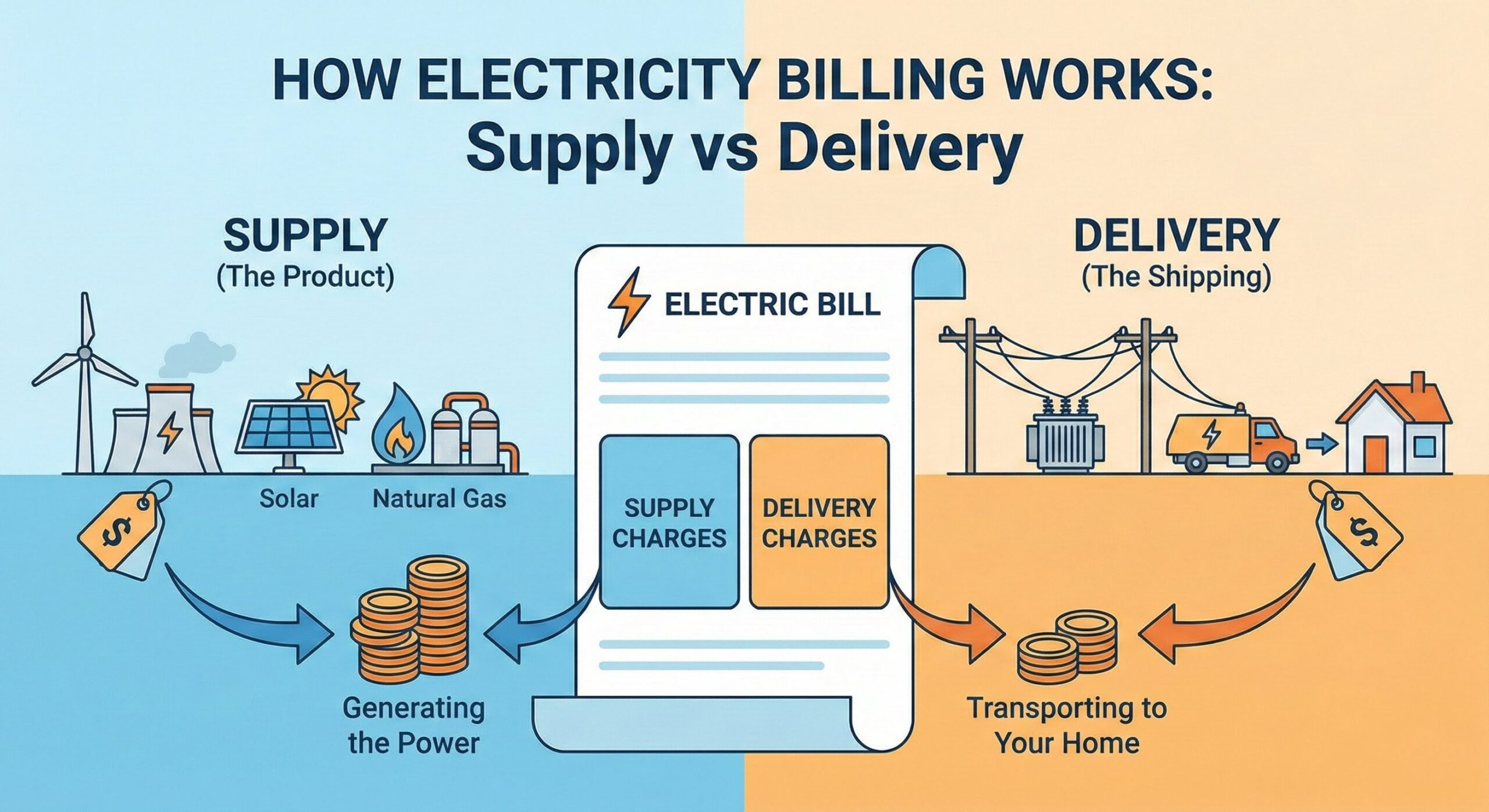
TL;DR: To understand supply vs delivery charges, think of your electric bill like an online order. You pay for the “item” (Supply) and the “shipping” (Delivery). In many states, you can shop around for a cheaper item, but you are stuck with the shipping company.
1. The “Envelope Dread”
We’ve all been there. It’s 2026, and you open your electric bill (or tap the notification on your phone). You see a number that makes your eyebrows hit your hairline. You used the same amount of power as last month, so why is the bill $40 higher?
Most people just look at the total due and grumble. But if you want to stop bleeding cash, you have to look under the hood. The secret to lowering your bill isn’t just turning off lights—it’s understanding the war between Supply vs Delivery.
2. Understanding Supply vs Delivery Charges (The Pizza Analogy)
If you’re not an electrical engineer, the grid is confusing. Let’s use pizza instead to explain the electric bill breakdown.
- The Supply Charge (The Pizza): This is the cost of the actual product—the electricity itself. It pays for the power plants (nuclear, wind, gas, coal) to generate the energy.
- Variable: The price changes based on how expensive “ingredients” (fuel) are.
- The Delivery Charge (The Driver): This is the cost to get the pizza to your door. It pays for the poles, wires, transformers, and the crew that fixes them during a storm.
- Fixed-ish: This is usually a set rate approved by the government. You can’t choose a different driver.
The Catch: In a lot of areas, the “Driver” (Delivery) is now charging almost as much as the “Pizza” (Supply).
Bill Buster Tip: You can’t fire the delivery guy (your local utility), but in deregulated states (like TX, PA, OH, NY), you can often fire the pizza place and find a lower electricity supply rate from a competitor.
3. The 2026 Cost Breakdown (Real Numbers)
Let’s look at what this actually costs the average American household right now based on data from the US Energy Information Administration (EIA).
The “Napkin Math” Assumptions:
- Average Home: Uses 900 kWh per month.
- Location: An average US state (blended rate).
- Total Rate: ~17.6 cents per kWh.
Here is how your supply vs delivery charges actually break down on a typical bill:
| Charge Type | Rate (approx.) | Monthly Cost | What it Pays For |
|---|---|---|---|
| Supply | 10.6¢ / kWh | $95.40 | Generating the power. (Coal, Gas, Solar, Wind) |
| Delivery | 7.0¢ / kWh | $63.00 | The poles, wires, meters, and storm repairs. |
| TOTAL | 17.6¢ / kWh | $158.40 | Total Monthly Bill |
Note: In high-cost states like California or Massachusetts, these numbers can be double. In low-cost states like Louisiana or Nebraska, they might be 30% lower.
Why this matters:
If you look at your bill and see your Supply rate is 14¢/kWh, but the market average is 10¢/kWh, you are overpaying by $36 a month just for loyalty to a bad plan. This is money you could use to offset the running costs of appliances like a space heater vs central furnace.
What you should do:
Grab your current bill. Circle the “Supply Rate” (sometimes called Generation Charge). Google “[Your State] electricity rates” and see if the current offers are lower than what you are paying.
4. The Verdict: Can You Win?
It depends entirely on where you live.
Scenario A: The Regulated Market (e.g., Florida, Minnesota, Wisconsin)
- The Situation: Your utility company is a monopoly. They own the power plants and the wires.
- Can you switch? No.
- Strategy: Your only defense is using less power. Focus on insulation, LED bulbs, and smart thermostats.
Scenario B: The Deregulated Market (e.g., Texas, Pennsylvania, New Jersey)
- The Situation: The utility owns the wires (Delivery), but independent companies compete to sell you the energy (Supply).
- Can you switch? Yes!
- Strategy: You must shop. Utilities in these states often have a “Price to Compare.” If you don’t shop, you often get defaulted to a higher variable rate.
Bill Buster Tip: Be careful of “teaser rates” in deregulated markets. A supplier might offer 8¢/kWh for 3 months, then jack it up to 18¢/kWh. Always read the “EFL” (Electricity Facts Label) or contract terms to understand fixed vs variable electric charges.
5. Smart Tools to Fight Back
You don’t need a degree in finance to track this.
- Smart Plugs with Energy Monitoring: Put these on your “always-on” devices (gaming PCs, older TVs). They will tell you exactly how many kWh those devices suck up, so you can calculate the Supply cost yourself.
- State Shopping Websites: Most deregulated states have official shopping sites (like PowerToChoose.org in Texas or PAPowerSwitch.com in PA). Use these, NOT the scammy third-party sites that hide fees.
What you should do:
If you are in a deregulated state, set a calendar reminder for 2 weeks before your current electricity contract expires. If you let it auto-renew, you will get ripped off.
6. FAQ
Q: When comparing supply vs delivery charges, can I ever lower the Delivery part?
A: Generally, no. Delivery charges are often a mix of a flat monthly fee (e.g., $15/month just to be connected) and a per-kWh fee. The only way to lower the per-kWh part is to use less electricity. You cannot negotiate this rate with the utility; it is set by state regulators.
Q: Why is my Delivery charge higher than my Supply charge?
A: This is becoming common, especially in the Northeast and California. Maintaining an aging grid, hardening it against wildfires/storms, and modernizing it for EVs is incredibly expensive. We are paying for infrastructure upgrades that were delayed for decades.
Q: If I switch cheap suppliers, will my power go out more often?
A: No. This is a common myth. Your local utility (the Delivery company) still manages the wires. If the power goes out, the utility fixes it, regardless of who you buy the “Supply” from. The electrons are exactly the same.