
TL;DR
If you are worried about your refrigerator electricity usage, here is the short answer: A modern fridge (2020 or newer) costs about $5 to $8 per month to run. However, an old “garage fridge” from the 1990s can cost $20 to $30 per month.
- The Rule: If your extra fridge is empty, unplug it. It’s costing you ~$200/year to keep air cold.
- The Fix: Vacuum the coils and keep it full (water jugs work) to stabilize the temperature.
1. The Only Appliance That Never Sleeps
Most appliances in your house are lazy. Your toaster works for 5 minutes a day. Your TV works for 4 hours. But your refrigerator? It is the marathon runner of your kitchen. It runs 24 hours a day, 7 days a week, 365 days a year.
Because it never turns off, your refrigerator electricity usage is likely one of the top three expenses on your utility bill, right behind your HVAC and your water heater.
But here is the tricky part: You can’t just “turn it off” to save money. You need it to keep your food safe. So, the question isn’t “how do I stop using it?”—it’s “is my specific fridge a localized energy disaster?”
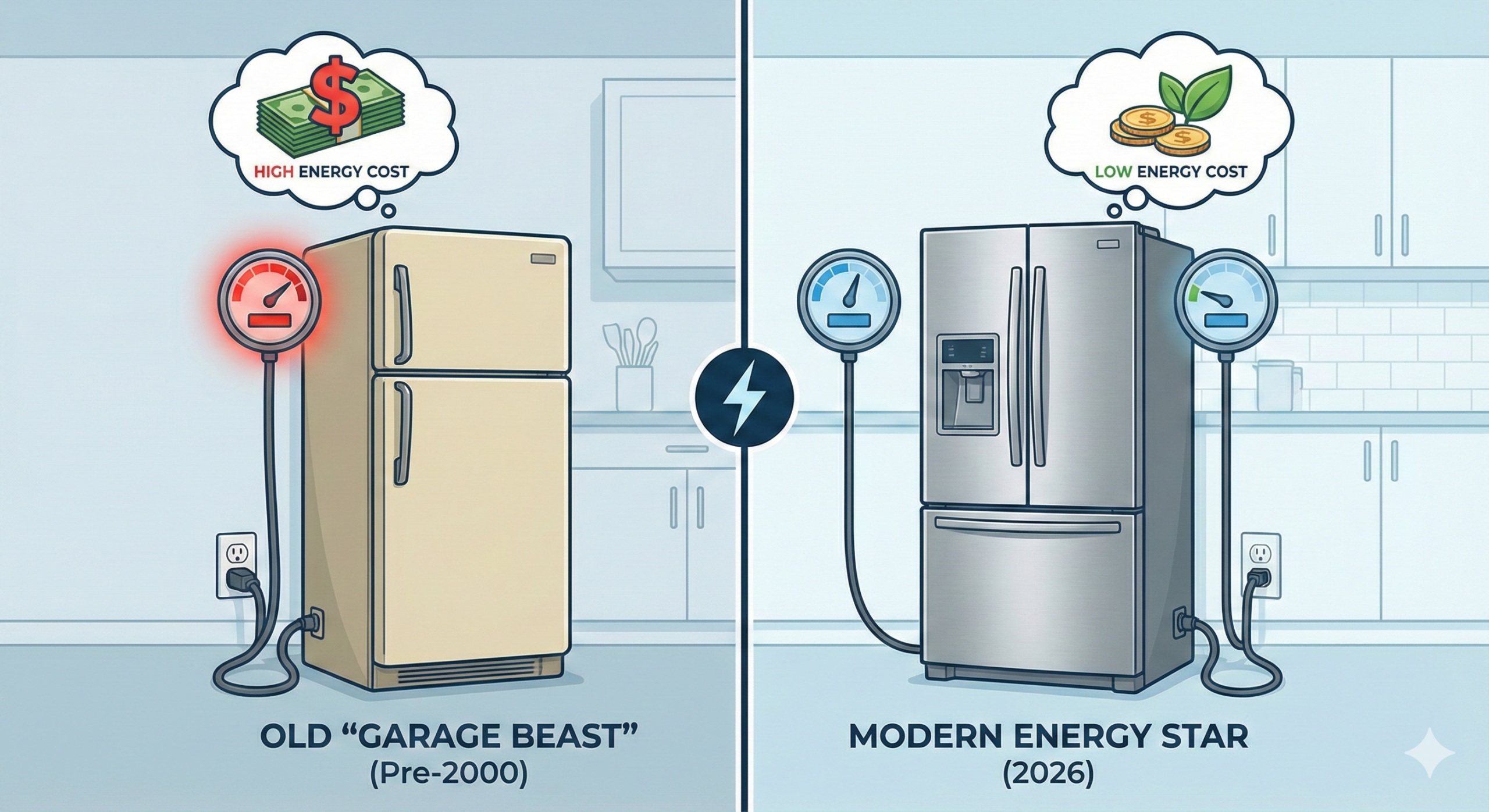
In 2026, the gap between a modern, efficient fridge and that clunky beast you kept in the garage is massive. Let’s look at the numbers.
2. Simplified Science: Understanding Refrigerator Electricity Usage
To understand why your bill is high, you need to understand how a fridge actually drinks electricity. It doesn’t run at full power all the time.
- The Compressor: This is the engine. When the inside gets too warm, the compressor kicks on (you hear the hum). This is when it uses high wattage (100–400 watts).
- The Idle Mode: Once the target temperature (usually 37°F) is reached, the compressor turns off. The fridge sits silently, using almost zero electricity, relying on its insulation to keep the cold in.
Why this matters:
Your refrigerator electricity usage depends entirely on Insulation and Seals.
- Good Insulation: The compressor runs for 15 minutes, then rests for 45 minutes. (Low Cost).
- Bad Insulation (Old Fridge): The compressor runs for 30 minutes, rests for 30 minutes. (Double Cost).
Bill Buster Tip: If you can hear your fridge running all the time (it never goes silent), your seals are likely broken or the coils are dirty. It is hemorrhaging money.
What you should do:
Perform the “Dollar Bill Test.” Close your fridge door on a dollar bill. If you can pull the bill out easily without resistance, your gasket (seal) is shot. Replace it for $30, or you are paying to cool your kitchen.
3. The Refrigerator Electricity Usage Breakdown
Let’s do the math using the 2026 national average electricity rate of $0.18 per kWh.
We will compare three common scenarios.
Scenario A: The Modern Energy Star (2020–2026)
- Size: 25 cu. ft. French Door.
- Efficiency: Excellent insulation, variable speed compressor.
- Average Consumption: ~400 kWh per year.
Scenario B: The “Average” Fridge (2010–2015)
- Size: Standard Top-Freezer unit.
- Efficiency: Decent, but seals are aging.
- Average Consumption: ~800 kWh per year.
Scenario C: The “Garage Beast” (Pre-2000)
- Size: The old side-by-side you moved to the garage “for beer.”
- Efficiency: Terrible. Plus, it’s fighting hot garage temperatures in summer.
- Average Consumption: ~1,700 kWh per year.
| Fridge Type | Annual kWh | Monthly kWh | Monthly Cost ($0.18/kWh) | Yearly Cost |
|---|---|---|---|---|
| Modern Energy Star | 400 | 33 | **$5.94** | $72 |
| Standard (10 yrs old) | 800 | 66 | **$11.88** | $142 |
| The Garage Beast | 1,700 | 142 | **$25.56** | $306 |
The Shocking Truth:
That “free” extra fridge in your garage is costing you over $300 a year. If you only keep a $10 case of soda in it, you are paying a 3,000% markup on cold drinks.
High vs. Low Cost States:
- In Washington (12¢/kWh): The Garage Beast costs ~$17/month.
- In California (35¢/kWh): The Garage Beast costs $50/month. (Yes, really. Get rid of it.)
What you should do:
Audit your “Second Fridge.” Is it full? If it’s mostly empty, consolidate the food into your main fridge and unplug the second one. If you only need it for parties, leave it unplugged until the day before the party.
4. The Verdict: Repair or Replace?
Homeowners often ask me: “Is it worth spending $1,000 on a new fridge just to save electricity?”
Let’s look at the ROI (Return on Investment).
- If your fridge is from 2015 or newer: Keep it. The savings of a new model (~$3/month) aren’t enough to justify the $1,000 price tag.
- If your fridge is from 2005 or older: Replace it. You will save ~$15–$20 per month. Over the 10-year life of the new fridge, you save $2,400 in electricity—which pays for the new fridge twice over.
The “Beer Fridge” Paradox:
People often buy a new efficient fridge for the kitchen and move the old, inefficient one to the garage.
- Result: Their total refrigerator electricity usage actually goes up because now they are running two machines, and the inefficient one is working harder in a hot garage.
What you should do:
Check the “Yellow EnergyGuide Label” if you still have it (or Google the model number). If the estimated usage is over 700 kWh/year, start budgeting for a replacement.
5. Smart Tools to Measure Exact Costs
You don’t have to guess. You can measure exactly how much your specific unit costs.
- The Kill-A-Watt Meter ($25):
- Unplug your fridge.
- Plug the Kill-A-Watt into the wall.
- Plug the fridge into the Kill-A-Watt.
- Leave it for 24 hours (fridges cycle on and off, so you need a full day’s data).
- Result: Press the “KWH” button. Multiply that number by 30 to get your monthly usage.
- Smart Plugs (with Energy Monitoring):
- Warning: Make sure the smart plug is rated for 15 Amps. Fridges have a high “startup surge.” If you use a cheap 10 Amp plug, you might melt it.
What you should do:
If you own a Kill-A-Watt, test your fridge for 24 hours. Write the cost on a sticky note and put it on the fridge door. It reminds family members not to stand there with the door open!
6. FAQ
Q: Does a full fridge use less electricity than an empty one?
A: Yes. Solids and liquids hold temperature better than air. When you open the door of an empty fridge, all the cold air falls out (it’s heavier than warm air) and is replaced by warm room air. The fridge has to work hard to cool that new air. If the fridge is full of food (or jugs of water), that cold mass stays inside, helping the fridge recover its temperature faster.
Q: Will putting hot food in the fridge raise my bill?
A: Slightly, but safety comes first. While your refrigerator electricity usage will spike briefly to cool that hot pot of chili, it is better than letting bacteria grow on the counter. To save energy, let the food cool to room temperature (for about 30 minutes) before putting it in.
Q: How much does the ice maker cost to run?
A: An automatic ice maker increases energy use by about 15–20%. It requires a heater to release the cubes from the mold and a motor to cycle them. If you want to save maximum money, turn off the ice maker and use old-school trays.