
TL;DR
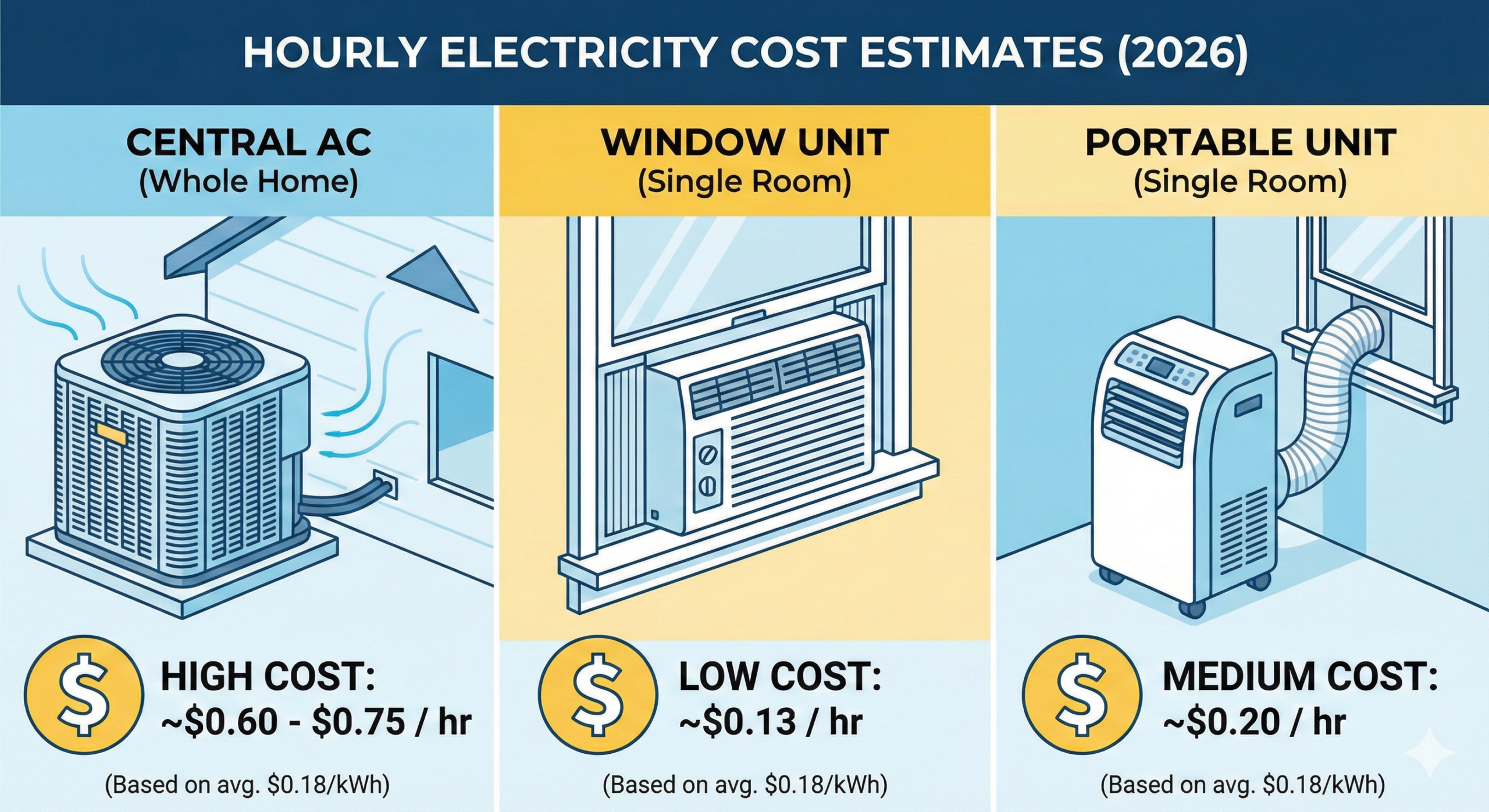
The average air conditioner electricity cost in 2026 is roughly $0.14 per hour for a window unit and $0.60 to $0.75 per hour for central air.
- The Reality: Running central AC for 8 hours a day adds about $150/month to your bill.
- The Fix: Raise the thermostat from 72°F to 78°F to drop that cost by ~30%.
1. The Sound of Money Evaporating
It is the sound of summer: the low hum of the condenser outside your window. For most of us, that sound means comfort. But for the budget-conscious, it sounds like a cash register opening and closing, over and over again.
Air conditioning is usually the single largest expense on a summer utility bill. When you open that envelope in August and see a $400 charge, 70% of that is likely just keeping your house at 70 degrees.
But knowledge is power. Most people have no idea if their AC costs $1 a day or $10 a day. They just close their eyes and pray.
Today, we are going to fix that. As a Home Energy Expert, I’ve crunched the 2026 numbers to give you a realistic breakdown of your air conditioner electricity cost, whether you are cooling a mansion with central air or a studio apartment with a window shaker.
2. Simplified Science: Watts vs. Cooling Power
Before we get to the dollar amounts, you need to understand why AC is expensive. It is not just blowing air; it is moving heat.
Think of your AC like a pump. It takes heat from inside your house and pumps it outside. The harder it has to pump (because it’s 100°F outside), the more electricity it burns.
The Magic Number: kWh
Your electric company charges you by the Kilowatt-Hour (kWh). In 2026, the national average rate is roughly $0.18 per kWh.
- Small Window Unit: Uses ~500 watts (0.5 kWh).
- Central AC: Uses ~3,500 watts (3.5 kWh).
The Efficiency Factor (SEER2)
You might see a sticker on your unit that says “SEER” or “SEER2.” This is the gas mileage of your AC.
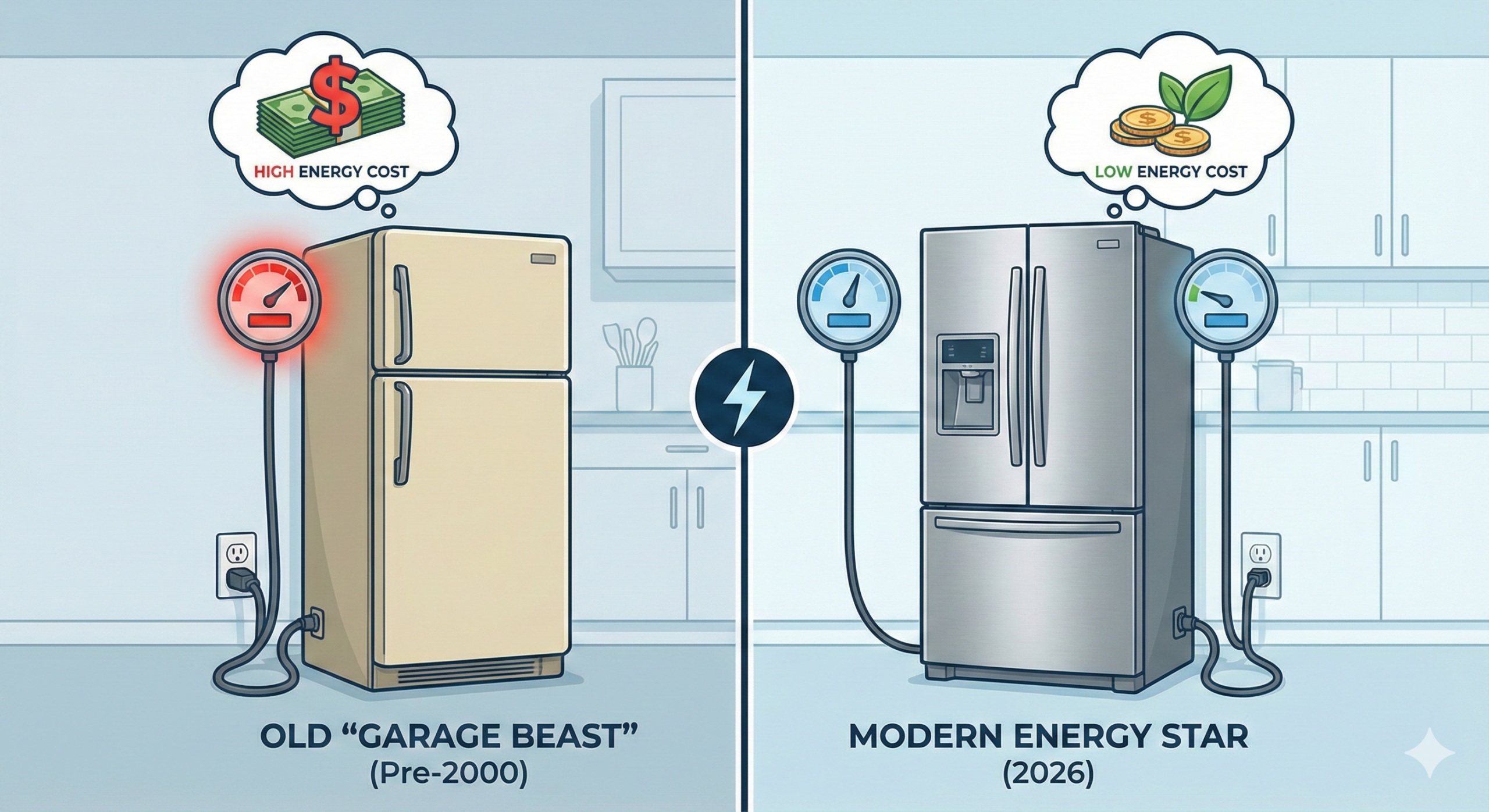
- Old AC (SEER 10): Like a gas-guzzling truck. High cost.
- New AC (SEER 16+): Like a hybrid. It cools the same amount of air using 40% less electricity.
Bill Buster Tip: If your central AC is older than 2010, you are likely paying a “clunker tax” of 30% extra on every bill just because the motor is inefficient.
What you should do:
Go outside to your condenser unit (the big box with the fan). Look for a yellow label. If the SEER rating is below 13, start budgeting for a replacement. It is costing you a fortune.
3. Air Conditioner Electricity Cost Breakdown (Hour, Day, Month)
Let’s get to the real numbers. We are using the national average rate of $0.18/kWh.
Note: If you live in California or New England, double these numbers. If you live in the Midwest or South, you might pay slightly less.
Category A: Central Air Conditioning (The Heavy Hitter)
This cools the whole house via ducts.
- Average Size: 3.5 Tons (3,500 Watts).
- Assumption: It runs for about 15 minutes every hour (a 25% “Duty Cycle”) on mild days, but runs constantly on hot days.
| Duration | Usage (kWh) | Est. Cost ($0.18/kWh) | Notes |
|---|---|---|---|
| 1 Hour (Running) | 3.5 kWh | **$0.63** | If running non-stop. |
| 8 Hours (Night) | 28 kWh | $5.04 | A full night of sleep. |
| 1 Month | 840 kWh | $151.20 | Assumes 8 hrs/day runtime. |
Category B: Window Units (The Room Coolers)
These cool a single room (150–400 sq ft).
- Average Size: 8,000 BTU (Medium).
- Power Draw: ~700 Watts.
| Duration | Usage (kWh) | Est. Cost ($0.18/kWh) | Notes |
|---|---|---|---|
| 1 Hour (Running) | 0.7 kWh | **$0.13** | Very affordable. |
| 8 Hours (Day) | 5.6 kWh | $1.01 | Cheaper than a coffee. |
| 1 Month | 168 kWh | $30.24 | Assumes cooling one room. |
Category C: Portable Units (The Inefficient Option)
These sit on the floor with a hose out the window.
- Average Size: 10,000 BTU.
- Power Draw: ~1,100 Watts.
- The Catch: They use more power to cool less space because the hot motor is inside the room with you.
| Duration | Usage (kWh) | Est. Cost ($0.18/kWh) | Notes |
|---|---|---|---|
| 1 Hour (Running) | 1.1 kWh | **$0.20** | 50% more than window units. |
| 8 Hours | 8.8 kWh | $1.58 | Adds up fast. |
| 1 Month | 264 kWh | $47.52 | For just one room! |
What you should do:
Look at your bill. If your air conditioner electricity cost seems too high, check if you are using portable units. Swapping a portable unit for a window unit can save you ~$17 per month per room.
4. Central vs. Window Units: The Verdict
This is the most common debate I hear: “Should I run the Central AC, or just put window units in the bedrooms?”
Let’s look at the math.
Scenario: It is 10 PM. You want to sleep cool.
- Option 1: Run Central AC to cool the whole empty house (Living room, kitchen, dining room, bedrooms).
- Cost: ~$0.63 per hour.
- Option 2: Run two Window Units (one in master, one in kids’ room).
- Cost: $0.13 + $0.13 = $0.26 per hour.
The Verdict:
If you are alone or just sleeping, Window Units win. They are roughly 60% cheaper because you aren’t paying to cool the kitchen while you sleep. However, if you have a large family occupying every room, Central AC becomes more efficient per person.
Bill Buster Tip: We call this “Zonal Cooling.” Use the Central AC to get the humidity out during the day, then switch to window units/mini-splits at night to save $3–$4 every single night. That is $120 a summer.
What you should do:
Don’t feel guilty about buying a window unit even if you have central air. Using it strictly for sleeping can pay for the unit in one summer.
5. Smart Tools to Lower the Cost
You don’t have to suffer in the heat to save money. You just need better data.
1. The Smart Thermostat (Ecobee / Nest)
- Why: It knows when you aren’t home.
- Savings: It raises the temp to 78°F when you leave for work. This reduces your air conditioner electricity cost by preventing the unit from cooling an empty house.
2. The Ceiling Fan (The Wind Chill Effect)
- Why: A fan doesn’t cool air; it cools skin. It costs only 1 cent per hour to run.
- Savings: Running a fan allows you to set the AC to 76°F but feel like it is 72°F. Every degree you raise the thermostat saves you 3% on your bill.
3. Thermal Curtains
- Why: Sunlight is essentially a space heater pointed at your floor.
- Savings: Blocking the sun prevents the heat from entering in the first place, meaning your AC runs less often.
6. FAQ
Q: Is it cheaper to leave the AC on all day or turn it off when I leave?
A: Turn it off (or up). There is a myth that “the AC has to work harder to cool the house down” and that this costs more. Physics says otherwise. The amount of heat entering your home is lower when the inside is warmer. By keeping it 72°F all day while you are at work, you are constantly fighting the heat. It is much cheaper to let it rise to 78°F or 80°F and cool it down when you return.
Q: Does a dirty filter really increase my bill?
A: Yes, significantly. A clogged filter restricts airflow. Your blower fan has to work twice as hard to push air through, and the coils can freeze up. A $5 filter can save you $20 a month in wasted electricity. Change it every 30 days in summer.
Q: How do I calculate my exact cost?
A: Find the wattage on your AC’s label (e.g., 1,200 W). Divide by 1,000 to get Kilowatts (1.2 kW). Multiply by your electricity rate (e.g., $0.18).
- Math: 1.2 kW x $0.18 = $0.21 per hour.