
TL;DR
If you are wondering what is a kWh, it is simply the unit you buy electricity in, just like you buy gas by the gallon.
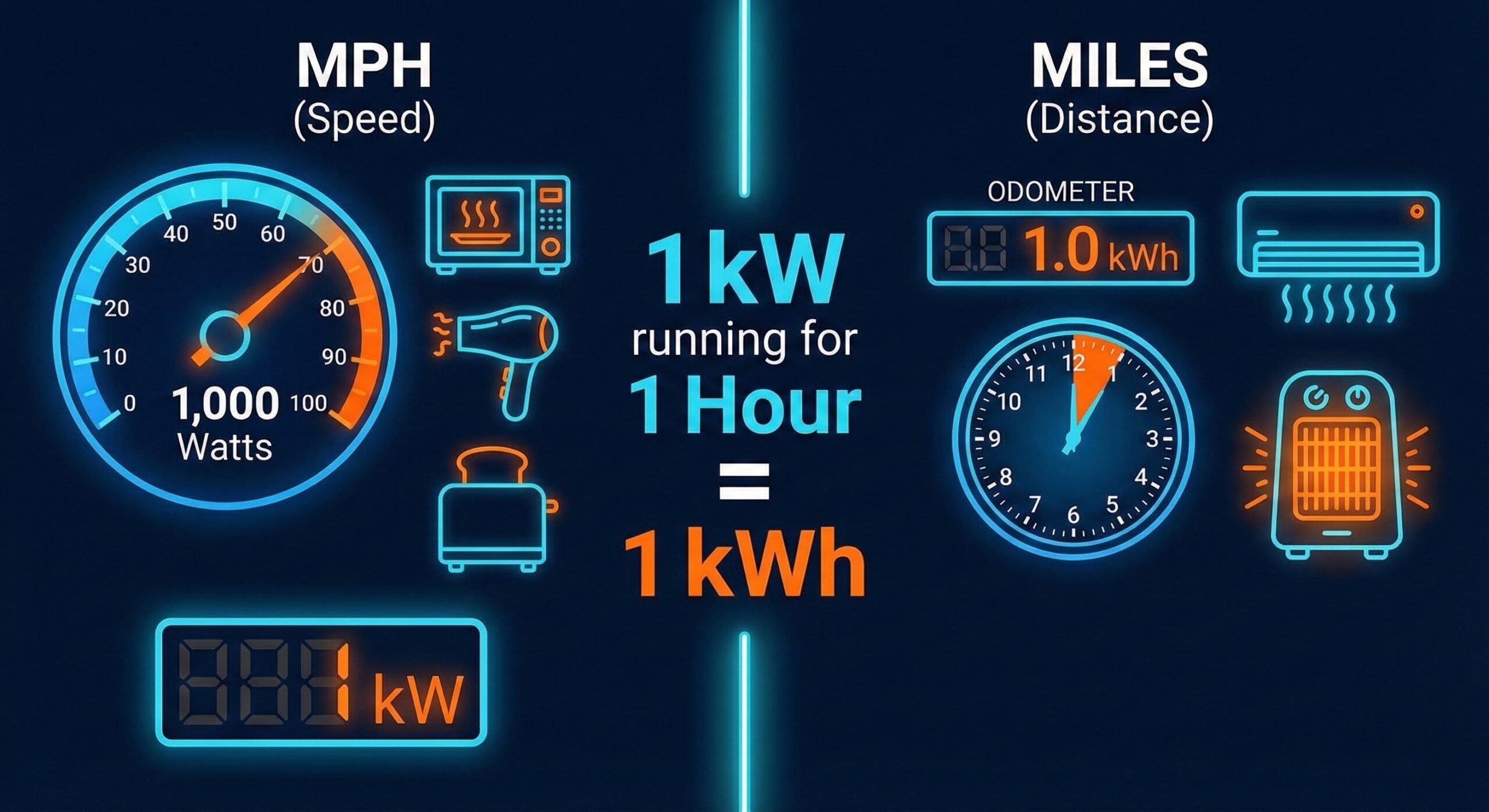
- 1 kWh = Running a 1,000-watt appliance (like a microwave) for one hour.
- The Cost: In 2026, the US average is about 18 cents per kWh.
- The Big Picture: Your bill is just
Total kWh Used × Price per kWh. If you lower the kWh, the bill must drop.
1. The “Invisible Product” Problem
Imagine going to the grocery store, filling your cart with invisible items, and then getting a bill for $160 at the end of the month. You’d be furious. “Did I buy steak? Or just a lot of beans?”
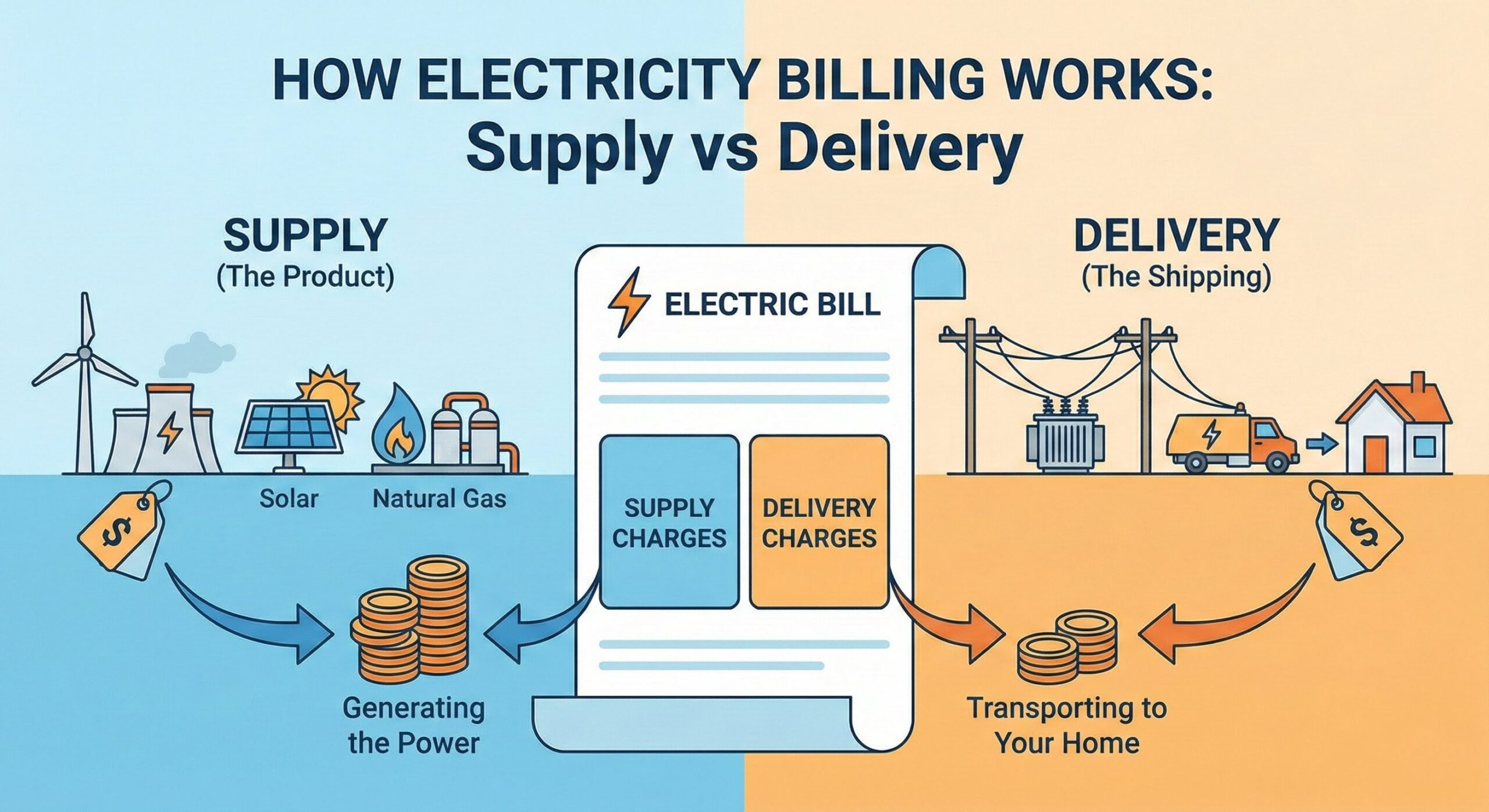
That is exactly how electricity billing works. You flip switches all month, and then a confusing piece of paper arrives demanding money.
Most homeowners ignore the details and just pay the total. But if you want to stop overpaying, you have to understand the unit of measurement: the kilowatt-hour (kWh). Once you understand what a kWh looks like in the real world, you can spot the energy vampires in your house instantly.
2. Simplified Science: What Is a kWh? (Speed vs Distance)
The biggest confusion is the difference between a kW (kilowatt) and a kWh (kilowatt-hour). They sound the same, but they are totally different.
Think of your car:
- kW (Kilowatt) is the Speedometer (MPH). It measures how “fast” you are using energy right now. A central AC unit runs “fast” (high kW). A customized LED nightlight runs “slow” (low kW).+1
- kWh (Kilowatt-hour) is the Odometer (Miles Driven). It measures the total distance you traveled. This is what you actually pay for.
The Golden Formula:
(Watts ÷ 1,000) × Hours Used = kWh
Example:
You have a 1,500-watt space heater.
- Divide by 1,000 = 1.5 kW (This is its “speed”).
- Run it for 10 hours.
- 1.5 kW × 10 hours = 15 kWh.
You just “drove” 15 kWh on your electric meter.
3. The 2026 Cost Breakdown
In 2026, the national average price for electricity is hovering around 18 cents per kWh.
However, this depends heavily on where you live.
- High-Cost Zones: California, Massachusetts, and Hawaii often pay 30¢–40¢+ per kWh.
- Low-Cost Zones: Louisiana, Washington, and Idaho can pay as little as 12¢–14¢ per kWh.
The “Price Tag” of Common Habits
Let’s stick a price tag on your daily activities using the 18¢/kWh average.
| Appliance | Speed” (Watts) | Time Used | Total kWh | Cost to You |
|---|---|---|---|---|
| LED Light Bulb | 10 Watts | 10 Hours | 0.1 kWh | $0.02 |
| Gaming PC | 400 Watts | 4 Hours | 1.6 kWh | $0.29 |
| Electric Dryer | 3,000 Watts | 1 Load (1 Hr) | 3.0 kWh | $0.54 |
| Space Heater | 1,500 Watts | 8 Hours (Night) | 12.0 kWh | $2.16 |
| Central AC | 3,500 Watts | 8 Hours (Day) | 28.0 kWh | $5.04 |
The Shocking Reality:
Running a space heater every night for a month doesn’t feel like a luxury, but look at the math:
$2.16/night × 30 nights = $64.80 per month.
That one small box could be 30% of your entire bill.
Bill Buster Tip: Heating and Cooling moves the needle. Lighting does not. Don’t stress about leaving a 10-watt LED bulb on (it costs 4 cents a day). Stress about the AC running when no one is home (it costs $5+ a day).
4. The Verdict: What Should You Focus On?
To lower your bill, you need to hunt down the appliances that have High Wattage AND Long Run Times.
Tier 1: The “Don’t Worry” List (Low Wattage)
- Phone chargers (5W)
- Wi-Fi Routers (10W)
- LED Bulbs (9W)
- Verdict: You can leave these plugged in 24/7. The savings aren’t worth the hassle.
Tier 2: The “Manage” List (High Wattage, Short Time)
- Microwaves (1,200W)
- Toasters (800W)
- Hair Dryers (1,500W)
- Verdict: These use a lot of power, but only for 5 minutes. Unless you are blow-drying your hair for 4 hours a day, these don’t ruin your bill.
Tier 3: The “Bill Killers” (High Wattage, Long Time)
- HVAC (AC/Heat): The undisputed king of the bill.
- Pool Pumps: These often run 8+ hours a day.
- Old Refrigerators: Especially that empty one in the hot garage.
- Electric Water Heaters: Keeping 50 gallons of water hot 24/7 is expensive.
What you should do:
Audit your home for Tier 3 devices. If you have a pool pump, put it on a timer. If you have a beer fridge in the garage that only holds 3 sodas, unplug it—it’s costing you ~$15/month to keep those sodas cold.
5. Smart Tools to Track kWh
You don’t have to do this math on a napkin. Technology is cheap in 2026.
1. The “Kill-A-Watt” Meter (~$20)
This is a simple device you plug into the wall, and then plug your appliance into it. It acts like a temporary electric meter.
- Use it for: Checking exactly how much power your PC, TV, or Window AC uses.
- Reality Check: You might find your “Energy Efficient” TV is actually burning 200 watts in standby mode.
2. Smart Plugs with Energy Monitoring (~$10/each)
Brands like Kasa, Wyze, or Eve offer smart plugs that track energy usage in an app.
- Use it for: Space heaters and Dehumidifiers. You can set them to turn off automatically if they use too much kWh.
3. Sense or Emporia Vue Home Monitors (~$150)
These install directly into your breaker panel (ask an electrician). They “listen” to the electrical noise in your house and tell you, “Your dryer just turned on.”
- Use it for: Total home domination. Seeing your real-time kWh usage drop when you turn off the AC is incredibly satisfying.
6. FAQ
Q: Does unplugging things actually save kWh?
A: Yes, but be selective. Unplugging a phone charger saves virtually nothing (maybe $0.50/year). However, unplugging a gaming console, laser printer, or older TV can save real money. These devices have “Vampire Load,” meaning they sip power even when turned off to keep their internal computers ready.
Q: How many kWh does the average house use?
A: In 2026, the average US home uses about 875 kWh per month. If your bill shows you using 2,000+ kWh and you don’t own an electric car or a pool, you have a serious efficiency problem (likely your HVAC or insulation).
Q: Is electricity cheaper at night?
A: Only if you are on a “Time-of-Use” (TOU) plan. Many utilities now offer plans where electricity is expensive from 4 PM–9 PM (Peak) and cheap overnight (Off-Peak). Check your bill. If you have a TOU plan, running your dishwasher or charging your EV at 11 PM could cost 50% less than doing it at 6 PM.